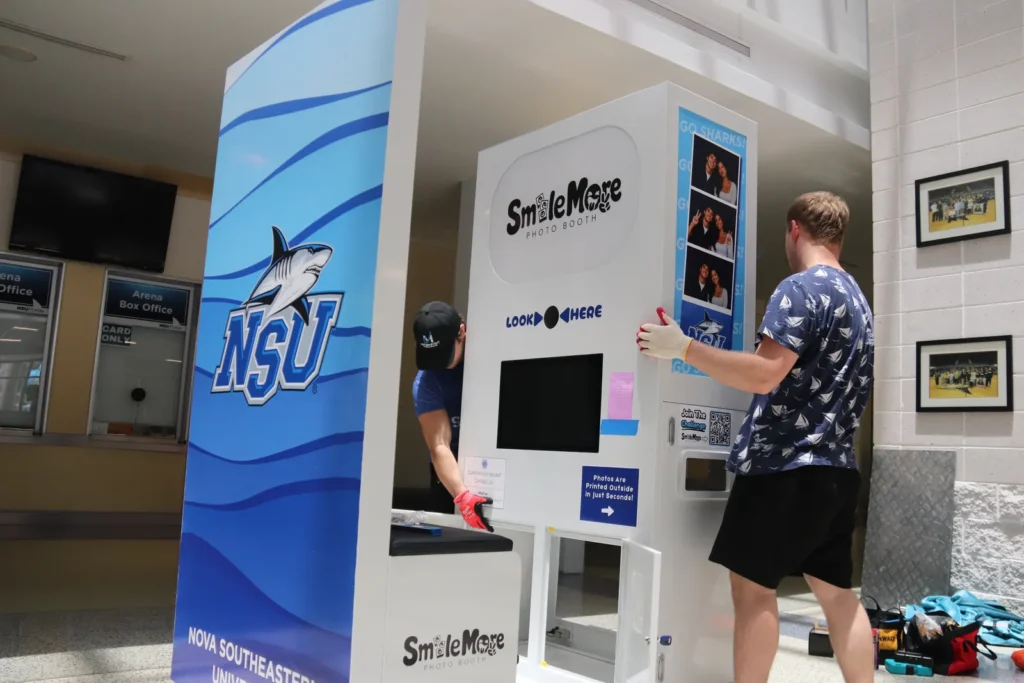
It is a Tuesday morning, an hour before you open. A van pulls up, two of our crew roll a metal cabinet through your front door on its casters, and by the time your first regulars walk in there is a curtained booth glowing in the corner. That is day one of a permanent photo booth for business, and it is the last day you will need to think hard about it. Below is what the weeks after look like: what happens, who handles it, and what shows up in your inbox.
The short version: we own the booth, install it, insure it, stock it and fix it. You give it a corner and an outlet. You get a share of every session, paid on the 1st of each month. The rest of this post is the long version, in the order you would live it.
Before install: one walkthrough and one agreement
Everything starts with a look at your space. We need roughly a 5 x 5 ft corner, one standard outlet, and a path from the door to that corner. The booth itself, our Classic, is a metal cabinet about 55 inches wide and 29 inches deep, and it rolls through a standard door. If you want to measure before we visit, our guide to photo booth dimensions covers clearances and where booths tend to fit best.
During that review we also agree on two numbers. The first is your share, somewhere between 10% and 25% of every session, written down before anyone signs. The second is the guest price, which we set together based on your crowd and your room. Then comes the agreement itself: 12 months, with a 90-day trial at the front. If you want to know what to look for in that paperwork (ours or anyone’s), read our breakdown of a photo booth placement contract.
The last pre-install step is the fun one. We design a wrap in your colors and logo, and we set up the strip template so your venue name prints on every strip that leaves the booth.
Install day: shorter than a staff meeting
The booth arrives, rolls in, plugs into the outlet, and we run test sessions until the prints look right and the payment reader is taking taps. Payment is a card or a phone tap at the booth itself, so there is no cash drawer to reconcile and nothing for your bartender or host to ring up.
Your staff briefing takes about as long as reading this paragraph. Their job, if a guest asks how it works, is to point at the screen. We added clear on-screen start guidance after watching the first guests at our NSU booth pause over what to press first, so the booth now does the explaining itself.
If you are already picturing your own corner, here is how hosting a SmileMore booth works, start to finish.
The first month of a permanent photo booth for business
Week one is the loudest week
New things get attention, and a booth with a curtain and a flash gets a lot of it. People walk over on purpose. They pull friends off their barstools. They come back the next night with the specific people they wanted in the picture.
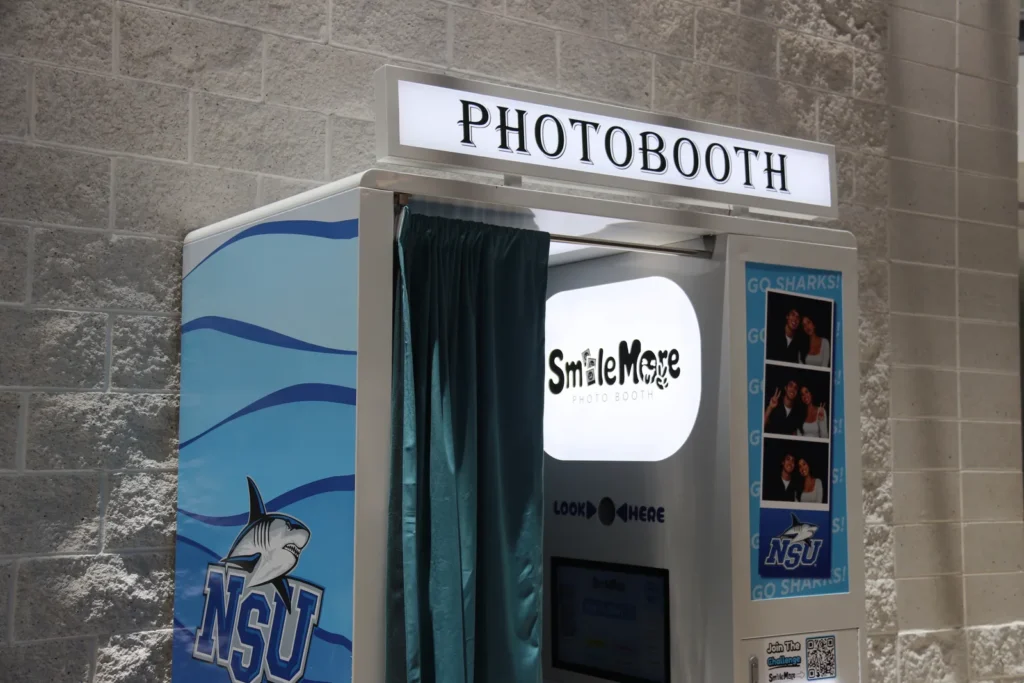
We saw exactly that pattern at our first live location, the lobby of the Don Taft University Center at Nova Southeastern University in Davie. That booth opened in August 2026, timed with move-in, and that first month it logged more than 300 paid sessions, with guests spending somewhere around $2,400. We want to be straight about what that number means: most of it landed during move-in week, so it is a launch month, not a forecast. We also had an early hardware fault that month, which our crew fixed. New machines have bugs. What matters is how fast someone shows up. The full story is in our NSU case study.
Weeks two through four: it becomes part of the room
After the opening rush, the booth settles into being a thing your place is known for. Regulars bring out-of-town visitors to it. Birthday groups plan around it. Each visit is four poses, then two printed strips drop in roughly 90 seconds, and a QR code hands over the digital copy, which is how your room ends up on their phones and in their group chats. Anyone who tags @smilemore.photobooth can get reposted on our Instagram and the SmileMore Wall, which is one more place your venue name shows up.
The cashless setup matters more than it sounds. According to the Federal Reserve’s 2025 Diary of Consumer Payment Choice, cash made up just 14% of U.S. consumer payments in 2024, while credit and debit cards together accounted for 65%. A booth that only took bills would be asking most of your guests to go find an ATM. Ours takes the card or phone they already have in hand.
Got a quiet corner doing nothing?
Tell us about your space and we will tell you honestly whether a booth fits. No cost to host, and a 90-day trial if it does.
The 1st of the month: a report and a payment
On the 1st, two things arrive. One is your payment. The other is a sales report showing what the booth did that month, so the share you receive is something you can check, not something you have to take on faith.
That report is also useful for spotting your own patterns. Maybe Thursdays outperform Saturdays. Maybe a trivia night or a live set moves the needle. You did not hire anyone or buy anything to get that data. If you want the math behind the percentage, our post on photo booth profit share walks through how it is calculated and what to ask about it.
Service, paper and repairs: the part you never see
We monitor every booth remotely, so we often know the paper is running low or something is acting up before anyone on your floor notices. Restocking happens in person. When something does break, a local crew is usually there to fix it the same day. Paper, parts and labor are on us, and so is the insurance on the booth.
Sometimes a booth needs to move: a renovation, a new floor plan, a facilities rule. At NSU, the university required the booth to be movable, and we handle relocating it, not their staff. Same deal for you. That is the quiet rhythm of a permanent photo booth for business once the launch buzz settles. If you are curious what upkeep a booth actually needs, our photo booth maintenance guide spells it out, though under a placement none of it is your job.
Day 90 and the rest of the year
The 90-day mark is a real checkpoint, not a formality. If the booth is not working for your venue by then, we take it out at no cost and you have lost nothing but a corner for three months. If it is working, the 12-month agreement simply carries on: monthly payments, monthly reports, same-day fixes, fresh paper.
One note on timing. We are early. NSU is our first live booth and more are in setup, so we only take on a handful of venues at a time. That is good for you if you get in now, because every new location gets close attention from the founder. Thomas Steckman is an NSU marketing graduate based in Davie who spent years running event photo booth rentals before SmileMore, so he has stood next to a booth at hundreds of weddings, parties and corporate events and knows what keeps a line forming.
What owners ask before saying yes
Do my employees need any training?
No. The screen walks people through paying and posing, and paper and repairs are ours to handle. If a guest has a question, your team can point them to the screen or to us.
What if the booth acts up on a busy Saturday?
We watch every booth remotely, so a fault usually reaches us quickly. A local crew is usually on site the same day. You do not need to troubleshoot anything yourself.
Will it clash with my interior?
It should not. The Classic comes in white or brushed metal, or with a full custom wrap in your colors and logo, and your venue name prints on every strip.
Can I end it if it is not a fit?
Yes. The agreement opens with a 90-day trial. Day 90 is your exit ramp, with free removal if the booth hasn’t earned its spot.
Here is our commitment: if you give us the corner, we will handle everything else and show you every month exactly what it earned. If that sounds like a fair trade, check whether your space qualifies and we will set up a walkthrough.