A photo booth profit share is the slice of every paid session that goes to the venue hosting the booth. With SmileMore, that slice is 10% to 25% of each session, agreed in writing before you sign, and paid on the 1st of every month alongside a sales report. You don’t buy the booth, rent it, or pay to have it delivered. We bring it, keep it stocked and fixed, and you collect a percentage of what guests spend inside it.
That’s the short version. The rest of this post covers what decides where you land in that range, how to read the monthly numbers, and the questions you should ask any company (us included) before agreeing to a split.
How a photo booth profit share actually works
Every placed booth runs on the same basic deal. The booth company owns the equipment and carries the costs. The venue supplies the floor space, the power outlet and, most importantly, the people. Every guest pays the booth directly with a card or a tap of their phone, and your agreed percentage of those sessions flows back to you.
Nobody on your staff touches money. There is no cash box to count, no float to reconcile and no tip jar confusion. The booth takes the payment, logs the session and prints two strips in about 90 seconds. At the end of the month we total the sessions, apply your percentage and send the payment with a report you can actually read.
Think of it less like leasing out a corner and more like a partnership on an attraction. The booth only earns if guests walk over to it, and guests walk over because it is fun to cram three friends onto a bench behind a curtain. Your share grows when the booth becomes a reason people visit.
What moves your split between 10% and 25%
We set the percentage during a short review of your space, and it is locked into the agreement before anyone signs. A few things shape it.
- Expected traffic. A packed weekend bar and a quiet daytime boutique are different bets for us, and the split reflects that.
- Placement. A booth in a visible spot near where people gather earns more than one tucked behind a hallway door.
- Hours. A venue open late seven nights a week gives the booth more chances to run than one open a few afternoons.
- The guest price. We set the session price with each venue during review, so it fits your crowd. We don’t publish a general price because there isn’t one.
What doesn’t move it: fees. We don’t take a setup fee, a service fee or a paper fee out of your share. The percentage in the agreement is the percentage on the report. If you want to see how the numbers might look for your room, start with our hosting page and tell us a bit about the space.
The arithmetic, without the hype
The math is simple on purpose. For every $100 guests spend in the booth, a 10% split sends $10 your way and a 25% split sends $25. That’s it. No tiers that reset, no minimums you have to hit before the share kicks in.
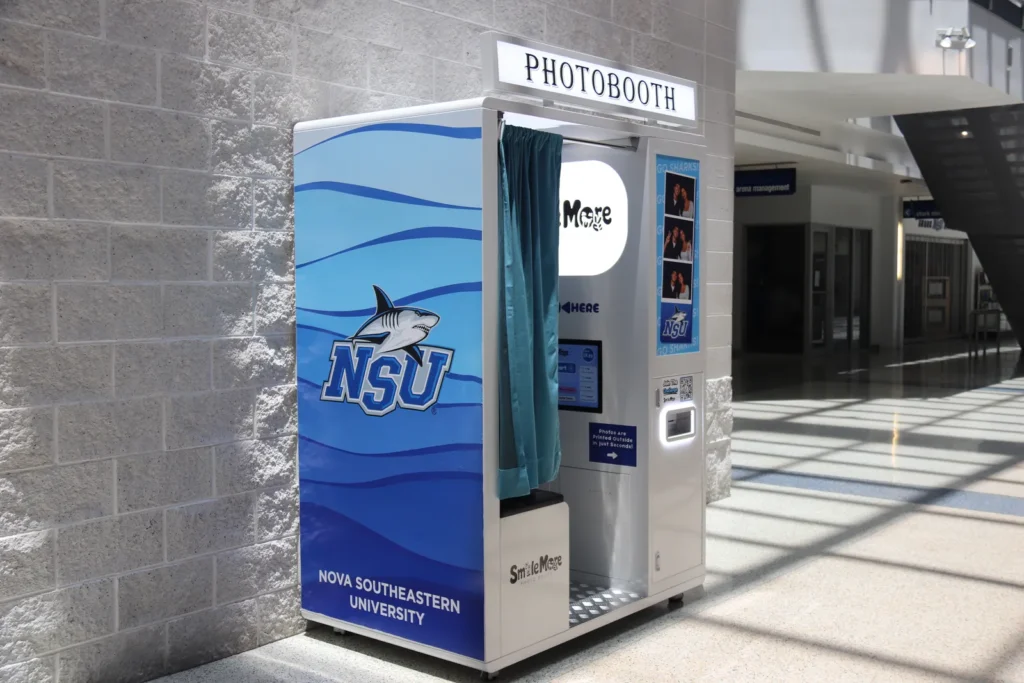
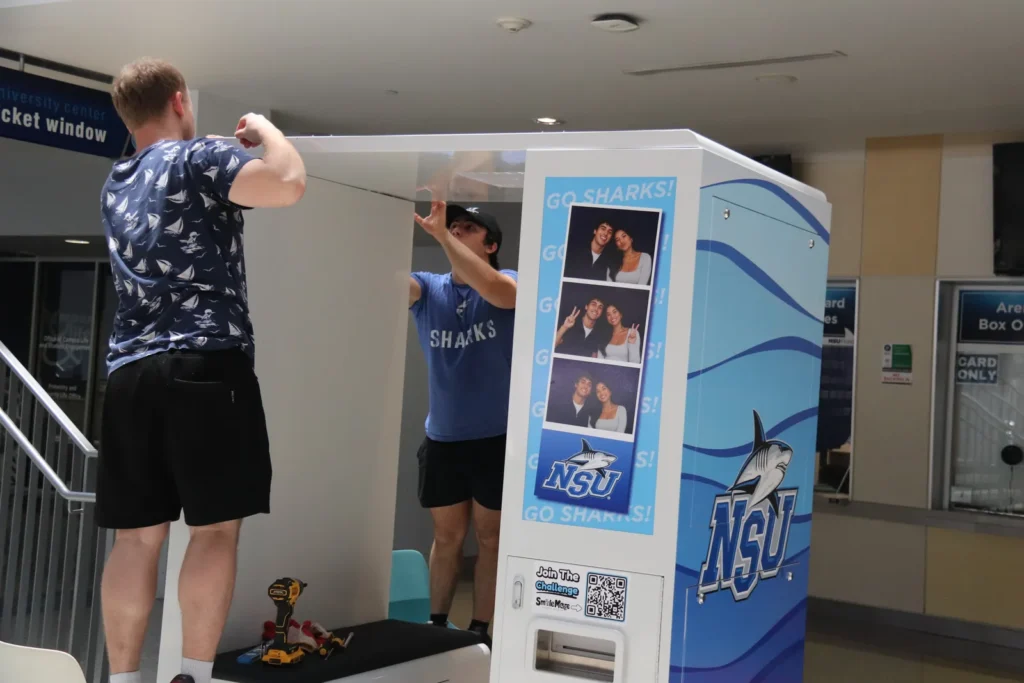
What’s harder to predict is volume, and anyone who hands you a confident monthly figure before the booth is installed is guessing. Here is what we can point to honestly. In August 2026, its first month, our debut booth at Nova Southeastern University (it stands in the Don Taft University Center lobby) logged more than 300 paid sessions. Guests spent roughly $2,400 that month. A lot of that came during move-in week, when the whole campus was new to the booth, so we don’t treat it as a steady pace. The full NSU case study walks through what happened, including an early hardware fault we fixed.
The point isn’t that your venue will match those numbers. It’s that the booth is a real attraction that people pay to use, and the profit share gives you a cut of that without risk.
What the monthly report should show you
A payment with no breakdown is a trust exercise. A good report removes the need for trust. Ours comes with every payment on the 1st, and it is built to answer the questions an owner actually asks.
At minimum, you should see the number of paid sessions for the month, total guest spend, your percentage and the resulting payment. Session counts by day or week are useful too, because they show you which nights drive the booth. If Thursdays are surprisingly strong, that tells you something about your Thursday crowd, and it might change how you promote that night.
Ask any provider for a sample report before you sign. If they can’t show you one, you won’t get one later either.
Why a percentage beats a flat rent check
Some booth arrangements pay the venue a fixed monthly rent for the space. That sounds tidy, and for a few venues it might be. But it changes who cares about the booth.
When the venue is on a flat rent, the booth company has every reason to minimize service visits and no particular reason to make the booth great. When both sides earn from every session, both sides want the booth clean, stocked, working and placed where people see it. Our team restocks it in person and watches it remotely, and when something breaks a local tech is usually on it the same day, because a broken booth costs us money too.
The percentage also scales with you. Busy season, a big event weekend, a new promotion: your share rises with traffic. A rent check stays flat no matter how much your crowd loves the thing.
Want to know what split your space would get?
Tell us about your venue and we’ll review the corner, the crowd and the right guest price, then put the percentage in writing before you commit to anything.
Questions to ask any booth company before you sign
Whoever you talk to, these questions separate a clean deal from a messy one.
What exactly is the percentage calculated on?
Get the base in writing. Is it total guest spend, or spend after certain deductions? Either can be fair, but you should know which one you’re agreeing to. Tax treatment matters here as well. Florida’s Department of Revenue, for instance, has published guidance on coin-operated amusement machines that turns partly on what a written agreement says about who the operator is when the machine owner and the business owner are different parties. That’s a good reason to have your accountant glance at any placement agreement, ours included.
When and how am I paid?
A fixed date and a report beat “periodically.” We pay on the 1st of each month, every month.
What does it cost me if the booth underperforms?
The correct answer is nothing. Our term is 12 months, and the first 90 days work as a trial. If the fit disappoints you by day 90, we haul it away and you owe nothing. Our photo booth contract guide covers the other terms worth checking, and the hosting FAQ answers the rest.
Who is responsible if something breaks or gets damaged?
We insure the booth, and repairs are on us. Make sure any agreement you sign says the same thing in plain language.
Profit share questions owners bring up
Can the percentage drift after the booth is installed?
No. The split is written into the agreement before you sign, so the number you agreed to is the number applied every month of the term.
Do I owe anything in a slow month?
Never. A photo booth profit share is a percentage of sessions, so a slow month means a smaller payment, not a bill. There is nothing to buy and no minimum to cover.
Will my bartenders or front desk have to handle booth payments?
No. Payment is card or phone tap, handled at the booth itself. Your team never takes cash, makes change or answers for a payment problem.
Is hosting better than buying a booth outright?
For most venues that want the attraction without the upkeep, yes, but it depends on how hands-on you want to be. For the buy-or-host math, read whether a photo booth is a good investment, which puts both paths next to each other.
Here’s our commitment: the percentage you see in your agreement is the percentage on every report, with no fees carved out of it and no surprises on the 1st. We’re early, with one booth live and more in setup, and spots are limited because we take projects as they come. If your venue has a busy corner and a crowd that likes a good photo, check whether your space qualifies and we’ll take it from there.